
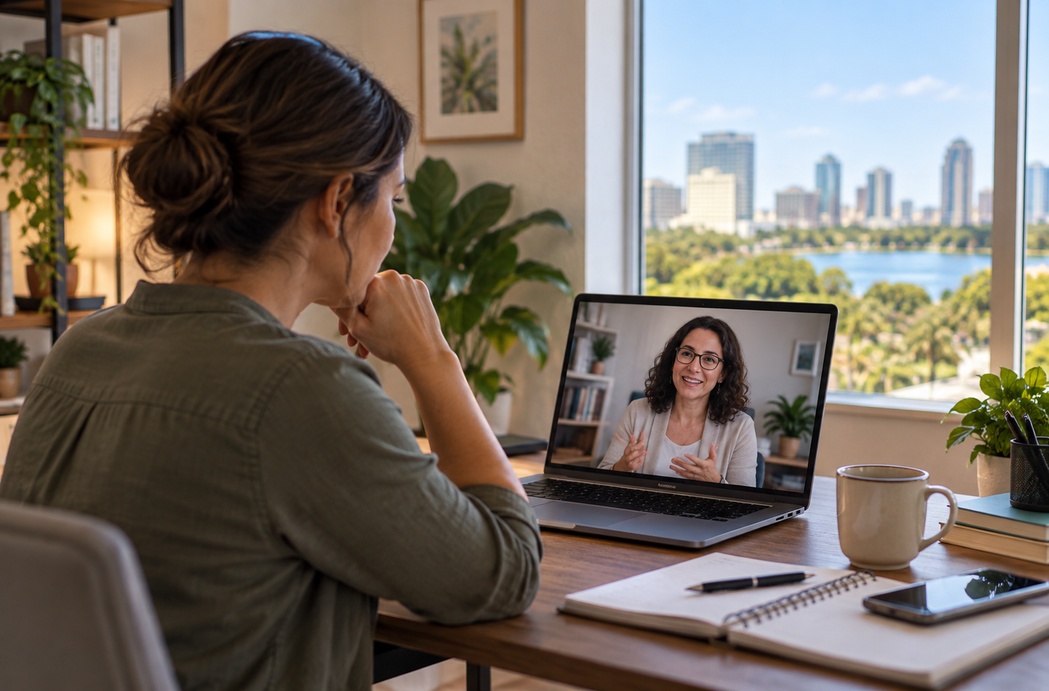
The most common reason busy Orlando professionals give for not starting therapy is not doubt that it would help. It is the logistics. A commute to an office, a waiting room, and a session that eats a full afternoon is genuinely hard to fit around a demanding job and a full life at home. Virtual therapy removes most of those barriers. Evolve Counseling and Wellness offers secure online sessions designed around real schedules. Call (407) 616-5948 or reach out online to schedule your first appointment.
Orlando professionals who have been putting off therapy usually know they should not be. The stress, the exhaustion, the sense that they are running at a level that is not sustainable, all of that is not getting better on its own. What has been getting in the way is the math: another commitment in a week that is already full does not fit, even when that commitment would make everything else more manageable. Virtual therapy changes the math enough that people who have been delaying for months or years find themselves actually starting. Here is how it works and what to realistically expect.
How Do Secure Video Sessions Work and What Should You Expect?
A virtual therapy session uses a HIPAA-compliant video platform, which means the connection is encrypted and private in the same way a secure patient portal is. The session is not conducted over a standard video call application. The therapist sends a link before the appointment, you click it from your phone, tablet, or computer at the scheduled time, and the session begins. There is no software to install, no account to create, and no technical setup beyond having a device with a camera and a reasonably stable internet connection.
What the session feels like is very close to what an in-person session feels like, with the practical difference that you are in your own space rather than a therapist's office. Most clients find that the slight informality of being in a familiar environment works in their favor. There is no performance pressure associated with a formal office setting, and many people find it easier to be direct and honest when they are sitting in their own chair at their own desk rather than in an unfamiliar room. The therapeutic relationship and the quality of the work are not diminished by the screen between you, which is something most people discover within the first session rather than having to take on faith.
Privacy during the session is worth thinking through in advance. A parked car, a private office during lunch, a bedroom with the door closed, or any other space where you can speak without being overheard for fifty minutes is sufficient. The therapist is experienced at working with the reality that clients are joining from their actual lives rather than from a soundproofed studio, and a minor background noise or a brief interruption is not going to derail the session. What matters is that you have enough privacy to speak freely.
How Do Busy Professionals Actually Fit Therapy Into Lunch Breaks or Evenings?
One of our clients had been thinking about therapy for over a year before he actually started. He had a demanding professional role, two young children, and family commitments that filled the hours around work. Every time he considered scheduling an appointment, the logistics defeated him before he got there. A commute to an office, the time the session itself would take, and the commute back meant giving up an evening or taking a long midday break that his workload did not allow. When he learned that virtual sessions were available during his lunch hour, the equation changed. He started meeting with us from his office during that hour, and the shift in how he felt over the following months was, by his account, something he wished he had not put off so long.
Lunch hour sessions work well for professionals whose midday is more controllable than their mornings or evenings. A fifty-minute session that starts at noon or twelve-thirty fits within a standard lunch break, leaves time to decompress briefly before the afternoon begins, and does not require leaving the building. Evening sessions work for people whose schedules are more predictable after five and who prefer to separate therapy from the workday. Early morning sessions before the day starts work for people who have more energy and clarity at that time than they do later. The scheduling flexibility of virtual therapy is genuinely broader than in-person, because the therapist's time is available in the same window, but the client does not need to add transit time on either side.
Consistency matters in therapy more than the specific time slot, so the right session time is the one you can actually keep rather than the one that sounds ideal in theory. A lunch session that gets pushed every week because something comes up at work is not the right fit, even if lunch looked available when you booked it. An evening slot that you can protect because you have shifted a standing commitment is a better practical choice. Being honest with yourself about which time in your week is actually reliable helps you build a therapy practice that lasts rather than one that starts and stops with your schedule.
Is Virtual Therapy as Effective as In-Person for the Concerns Most Orlando Professionals Have?
The research on this question is reassuring. Studies comparing in-person and virtual therapy outcomes for anxiety, depression, stress, burnout, and relationship concerns have consistently found that the two modalities produce comparable results. The therapeutic relationship, which is the strongest predictor of therapy outcomes, develops through virtual sessions in much the same way it does through in-person sessions, and the evidence-based approaches therapists use translate without meaningful loss to a video format.
The concerns that bring most overextended Orlando professionals to therapy, including burnout, chronic stress, difficulty managing the demands of a high-pressure career, anxiety about performance or the future, and the erosion of relationships under the weight of an overfull life, are well-addressed in a virtual format. These are primarily conversational and cognitive concerns rather than ones that require physical presence, and the intimacy and honesty that make therapy effective can be established through a screen in the same way they are established in a room.
There are situations where in-person therapy is the clearer clinical recommendation, and a therapist who is being honest with you will say so if your situation is one of them. For the range of concerns that most busy professionals bring to therapy, virtual sessions are not a compromise. They are a format that has been validated by research and by the experience of millions of people who have used it, and that has the practical advantage of fitting into lives that an in-person-only option would not reach.
What Are the Simple Steps to Get Started With Virtual Therapy?
Starting virtual therapy involves fewer steps than most people expect. The first is reaching out to schedule a consultation or a first session. That contact can be a phone call or an online message, whichever feels easier in the moment, and it typically takes five minutes. The therapist's team will confirm your availability, explain the logistics of the secure video platform, and answer any practical questions before the first appointment.
Before the first session, you will complete intake paperwork that collects background information and helps the therapist prepare for the conversation. This takes twenty to thirty minutes and can be completed at whatever time is convenient for you before the appointment, not in a waiting room right before you begin. The first session itself is a conversation, not an evaluation. You are not being assessed for a diagnosis or measured against a standard. The therapist is getting to know you, understanding what has been difficult, and beginning to build a picture of what you are hoping therapy will help you with.
If you are a professional whose work involves significant pressure and responsibility, the specific demands of high-stakes professional life are something a therapist with relevant experience understands. The particular stress of always being the one who has to have the answer, of managing others while feeling unmanaged yourself, or of maintaining a professional presentation while carrying a level of internal exhaustion that does not show at the office, are all things that come up in therapy with people in demanding careers and that are worth addressing rather than managing indefinitely on your own.
If you have been putting off starting because the logistics have not worked, virtual therapy may be the format that finally makes it possible. Evolve Counseling and Wellness works with Orlando professionals navigating demanding schedules and high-pressure careers, including through therapy for lawyers and therapy for managing emotional burnout. Call (407) 616-5948 or reach out online to schedule your first session at a time that actually works for your week.