
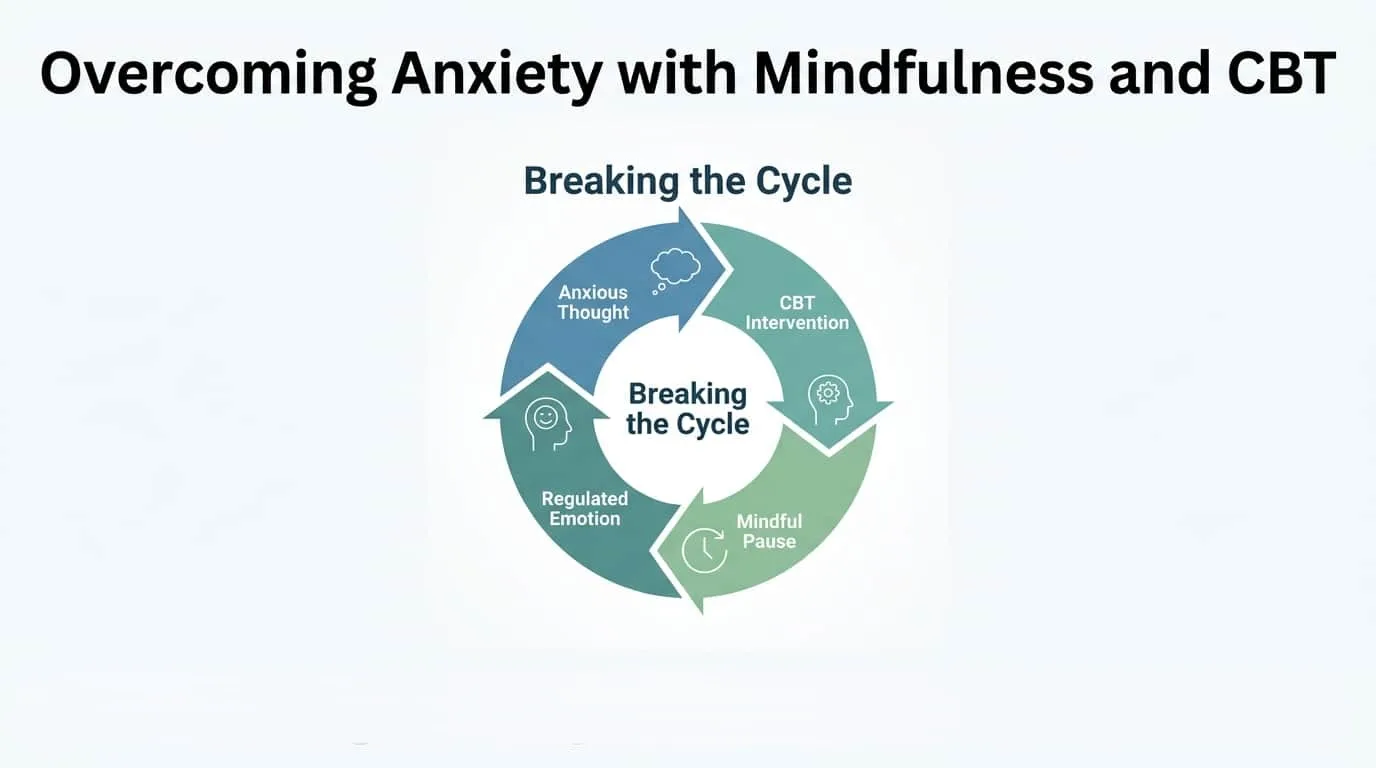
Anxiety affects about 40 million adults in the United States every year, making it the most common mental health condition in the country. Here in Orlando, the pressure of demanding work schedules, busy family life, and constant noise can push stress levels well beyond what most people can manage on their own. If you've been searching for therapy Orlando Florida residents trust for real, lasting relief, this guide walks through how mindfulness and Cognitive Behavioral Therapy (CBT) can help you take back control.
Ready to talk to someone now? Evolve Counseling & Wellness offers a free phone consultation. Call (407) 616-5948 to get started.
What Does Anxiety Actually Feel Like for Orlando Residents?
Anxiety isn't just worrying. For many people living and working in Orlando, it shows up as a racing heart before a work meeting, trouble sleeping despite exhaustion, or a constant low-level dread that's hard to explain. Some residents describe it as feeling permanently "on edge," even when life looks fine from the outside.
Florida's pace doesn't help. Between commutes through Baldwin Park, long hours at work, and the financial pressures that affect families across Central Florida, many people reach a breaking point before they ever seek help. Research shows that untreated anxiety can reduce productivity by up to 50% and significantly strain personal relationships. Recognizing anxiety as a real, treatable condition is the first step toward changing that.
What Is Mindfulness, and How Does It Reduce Anxiety?
Mindfulness is the practice of paying deliberate attention to the present moment without judgment. Studies show that consistent mindfulness practice can reduce anxiety symptoms by 30 to 58% over an 8-week period. That's not a small shift. For many people, it's the difference between white-knuckling through each day and actually feeling steady.
Here are three practical techniques you can start using right now:
Grounding (the 5-4-3-2-1 method): Name 5 things you can see, 4 you can touch, 3 you can hear, 2 you can smell, and 1 you can taste. This pulls your nervous system out of fight-or-flight mode within minutes.
Diaphragmatic breathing: Inhale slowly for 4 counts, hold for 4, exhale for 6. Extending the exhale activates the parasympathetic nervous system, which signals to your body that you're safe.
Body scan meditation: Starting at the top of your head, slowly move your attention down through your body, noticing where you're holding tension. Even a 10-minute daily practice produces measurable changes in stress hormones over time.
These tools don't require an app, a retreat, or any prior experience. They work because they interrupt the automatic stress response that keeps anxiety locked in place.
How Does CBT Help Break the Cycle of Anxious Thinking?
CBT, or Cognitive Behavioral Therapy, works by identifying the thought patterns that fuel anxiety and replacing them with more accurate, balanced ones. A trained anxiety therapist uses CBT to help clients spot "cognitive distortions," which are mental habits like catastrophizing, all-or-nothing thinking, and mind-reading, that keep people stuck in cycles of rumination.
Here's a simple example. A person thinks, "I made one mistake at work, so I'm going to get fired." CBT helps them examine the evidence: Has anyone actually said their job is at risk? What's the realistic probability? What would they say to a friend thinking the same thing? Over time, these questions become automatic, and the anxious spiral loses its grip.
Most people notice meaningful progress within 12 to 20 sessions of CBT, though some see shifts much sooner. The skills you learn don't disappear when therapy ends. That's why CBT is considered one of the most well-researched, effective treatments for anxiety available today.
At Evolve Counseling & Wellness, CBT is one of the core approaches used in both in-person and virtual sessions. The practice also offers accelerated resolution therapy, a shorter-term option that uses bilateral eye movement to process anxiety and trauma more quickly than traditional weekly sessions.
Why Combining Mindfulness and CBT Works Better Than Either Alone
CBT and mindfulness target anxiety from two different angles. CBT challenges the content of anxious thoughts. Mindfulness changes your relationship to those thoughts altogether. Together, they build what therapists call emotional resilience, which is the ability to feel difficult emotions without being controlled by them.
Research published in peer-reviewed journals consistently shows that combining these two approaches produces stronger outcomes than using either method alone. Clients who use both tend to report faster progress, lower relapse rates, and a greater sense of personal agency over their mental health.
This integrated approach is especially effective for people who've tried managing anxiety on their own. Knowing what anxiety is and actually being able to regulate it in the moment are two very different things. Having a therapist who can guide you through both is what makes the difference.
Where Can Orlando Residents Find Local Mental Health Support?
Good support is closer than most people realize. Orlando has a growing network of mental health resources, and demand for therapy Orlando Florida providers has increased sharply over the last several years. Waitlists at larger practices can run 4 to 6 weeks, which is why finding an independent, experienced therapist can actually get you seen faster.
Residents in neighborhoods like Baldwin Park, Winter Park, and the surrounding areas have access to both in-person and virtual therapy options. If you're not ready for weekly sessions, some practices offer single-day intensives. These are six-hour focused sessions designed for people who need deeper work on one specific issue without the ongoing weekly commitment. They're a strong option for people with demanding schedules who still want meaningful progress.
Community support also matters. The National Alliance on Mental Illness (NAMI) has an Orlando chapter that runs free support groups and education programs. Online communities specifically for anxiety and mindfulness practice can complement professional therapy, though they work best as supplements rather than replacements for clinical care.
How Do You Build a Sustainable Mental Wellness Routine?
A sustainable routine doesn't need to be complicated. The people who make the most consistent progress tend to start small and build gradually over 4 to 8 weeks. Here's what that can look like in practice:
Week 1 to 2: 5 minutes of diaphragmatic breathing each morning. That's it. Don't add anything else yet.
Week 3 to 4: Add a brief evening journal check-in. Write one anxious thought from the day and one piece of evidence that challenges it. This is CBT in its simplest form.
Week 5 to 6: Try a 10-minute guided body scan before bed. Apps like Insight Timer offer these for free.
Week 7 to 8: Review what's working and what isn't. Adjust accordingly.
Pairing this kind of daily practice with professional therapy produces results much faster than either approach alone. A therapist who specializes in anxiety can also help you troubleshoot when you hit a wall, which most people do at some point.
Progress isn't linear. Some weeks feel solid. Others feel like a step back. That's normal, and it doesn't mean the approach isn't working.
Ready to Take the First Step Toward Feeling Better?
If anxiety has been running your life longer than you'd like to admit, you don't have to keep managing it alone. Evolve Counseling & Wellness offers therapy Orlando Florida residents can access through both in-person sessions in Baldwin Park and virtual sessions throughout the state. Dorian Race, LMHC, is a licensed therapist with specialized training in CBT, trauma-informed care, and accelerated resolution therapy, and she brings a calm, direct, collaborative style that clients consistently describe as genuinely helpful.
Call (407) 616-5948 today to schedule a free phone consultation. Taking 15 minutes to make that call could be the most useful thing you do this week.