
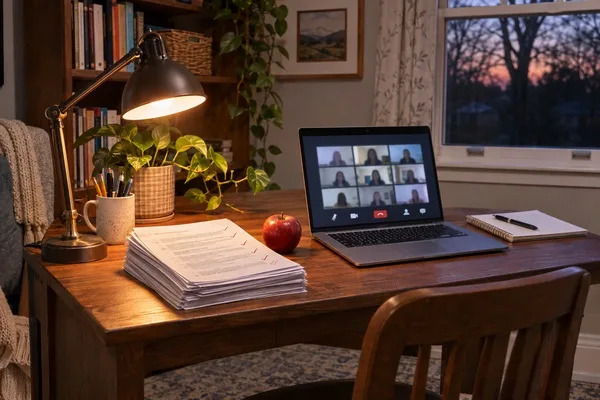
If the day-to-day grind is getting to you a few months into the school year, online therapy can provide a space to work through those feelings. Online counseling lets you start from your own couch after the final bell, without finding the energy for one more drive.
I am Dorian Race, a Licensed Mental Health Counselor at Evolve Counseling & Wellness in Baldwin Park. If you are a teacher feeling worn thin, reach out to me or call (407) 616-5948 for a free 15-minute phone consultation.
Why Do So Many Teachers Feel Empty by November?
By November, the energy of August has usually been spent. Teachers have been managing behavior, meeting administrative demands, and caring about every student for months, often with no real break in sight.
The weight is not only the workload. It is the student who seemed hungry on Friday, the one who stopped talking in class, the parent email you keep rereading. Many teachers tell me they replay those worries on the drive home down Corrine Drive and are still thinking about them at dinner.
Then there are the pieces outside your control. Curriculum changes arrive midyear. Testing pressure builds. New initiatives land on top of the old ones. You are asked to give more, with less time to recover between demands.
That combination can lead to something called compassion fatigue, a deep tiredness that comes from caring for others day after day. It does not mean you care less. It usually means you have been caring a great deal for a long time without anyone caring for you in return.
When Has Tiredness Turned Into Burnout?
Ordinary tiredness lifts after a good weekend. Burnout does not. It is a deeper exhaustion that affects your body, your mood, and how you treat the people around you.
Some signs are physical, like restless sleep, headaches, or catching every cold that moves through the building. Others are emotional. You might feel a constant low dread on Sunday nights, have thin patience with your own family, or lose interest in things that used to bring you joy, like a slow walk around Lake Baldwin.
Burnout also shows up in your thinking. Decisions feel harder, your mind feels foggy, and small tasks start to feel huge. Many teachers pull back from friends because they have nothing left to give, then feel guilty about that, too.
If several of these sound familiar, that is worth taking seriously. My work with emotional burnout therapy looks at what is underneath the exhaustion, including beliefs like "my worth depends on how much I get done," so you can start to refill instead of just pushing through.
How Does Online Counseling Make Starting Realistic?
Online counseling removes the drive, the waiting room, and the rush across town. You join a secure session from home, which makes it far easier to show up when you are already running low.
For a lot of teachers, the hardest part of therapy is not the conversation. It is the logistics. After grading, meetings, and car line duty, the idea of sitting in Semoran Boulevard traffic to reach an appointment can be enough to cancel before you start.
With online sessions, you can sit somewhere comfortable, close the door, and talk. There is no need to change clothes or plan a route. That small shift often makes the difference between thinking about counseling and actually beginning.
My therapy for teachers is shaped by an understanding of the school system and the pressures Central Florida educators face. I offer online sessions for teachers across Florida, and I also see clients in person at my Baldwin Park office if you ever prefer that.
What Does Counseling With Me Look Like?
Counseling with me is practical and paced to you. I listen first, then help you understand what is driving the exhaustion and what might help you carry less of it home each day.
Many teachers I work with notice patterns like perfectionism, over-responsibility, people-pleasing, or self-criticism. Those habits often grew from caring deeply, and they deserve kindness, not judgment. Together, you and I look at which ones still serve you and which ones are wearing you down.
I also use approaches such as Accelerated Resolution Therapy to help with stress, along with techniques that calm the nervous system's fight-or-flight response. Every person responds differently, so I check in often and adjust as you go. You will usually leave with one or two small, doable things to try before the next session.
When you are ready, call (407) 616-5948 or schedule your free consultation. You can tell me what this school year has been like, and you and I can see whether online counseling feels like the right next step.